In the March issue of Fruits, vegetables and flowers you will find the opinion article entitled “The role of InnovPlantProtect in Organic Farming: Paths to sustainable and efficient solutions”, in which the executive director of InnovPlantProtect (InPP), António Saraiva, reveals how our CoLAB is contributing to the success of organic farming.
“By boosting research, collaboration and knowledge sharing, InPP is helping to solve the central challenges of this practice [organic farming], allowing it to expand and enhancing the supply of agricultural products to consumers. The solutions developed by InPP make organic farming a more viable option for producers,” says the executive director.
Read the full article and find out how we are shaping the future of agriculture.
We thank Frutas, legumes e flores magazine for its recognition and reiterate our commitment to the agriculture of the future.
Imagine a future where drones and artificial intelligence work together to protect your vineyards. That's what the AI4Leafhopper project is making a reality!
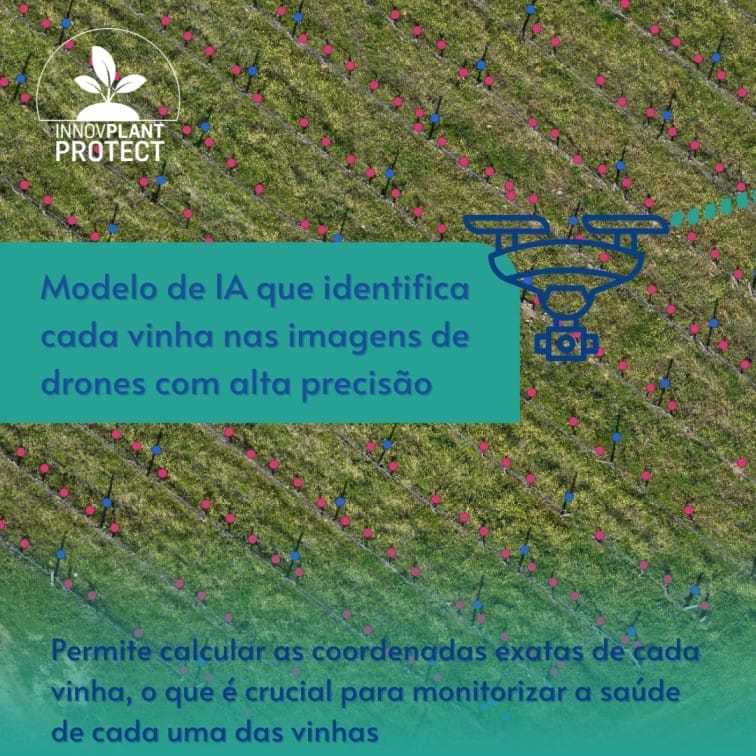
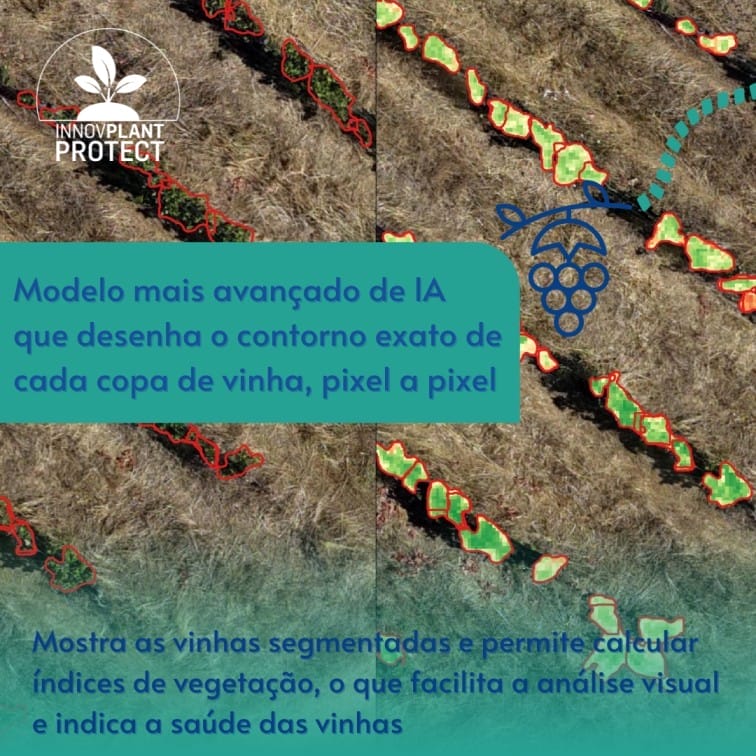
Manisha Sirsat, a researcher on the AI4Leafhopper team, has developed two artificial intelligence models that analyze the aerial images captured by our latest generation drone... and these models make it possible:
geolocation of each vine
to know if there are vine failures
quickly identify “sick” vines”
optimize the application of treatments
The result? Growers can have a detailed view of the health of their vineyards, detect problems early and make more informed decisions.
AI4Leafhopper is a project led by InPP and funded by the ICAERUS Horizon Europe program, which began in April 2024 and ended on April 30 with a final meeting involving the six European projects approved in the 1st edition of the ICAERUS program's PULL applications. The project team presented the AI-based models for detecting and monitoring the impact of the green leafhopper on vineyards.
The AI4Leafhopper project, InnovPlantProtect used a state-of-the-art drone to monitor the impact of the green leafhopper in the vineyards of our partners Reynolds Wine Growers and João Portugal Ramos. Although the results show that this advanced technology is more effective at detecting attacks at advanced stages, we are excited about the potential of this tool to provide valuable data for the management of this harmful insect.
We believe that with more research, we can refine our solution to detect early attacks and prevent significant damage to vineyards. Transforming the monitoring of this pest is where we want to go, always with the aim of protecting vineyards and guaranteeing the quality of production for winegrowers.
Over the next few days we'll be revealing everything that the AI4Leafhopper project is making a reality and how drones and artificial intelligence are working together to create a more sustainable future for viticulture. Stay tuned!
AI4Leafhopper, funded by the ICAERUS Horizon Europe program, which began in April 2024, is now in its final stages. The development phase of the project, which took place in the field, is now over and the final stage is to present the solutions developed by our team on Portuguese soil to the market.
InnovPlantProtect (InPP) took part in the debate session on breeding and genomic techniques, the subject of the most recent edition of the CULTIVAR publication by the Planning, Policies and General Administration Office (GPP), which took place on June 27 at the Marquês Hall of the Ministry of Agriculture and Fisheries in Lisbon.
The opening session was led by the GPP's director-general, Eduardo Diniz, and also included the participation of Pedro Fevereiro, executive director of the InPP, Benvindo Maçãs, director of INIAV, IP, Catarina Ginja, professor at the Center for Interdisciplinary Research in Animal Health (CIISA), Irina Castro, from the Transgenics Out Platform. The panel was moderated by Pedro Castro Rego, from the GPP.
As can be read in the news published on the GPP website: “During the debate, although there was no consensus on the subject, it was clear that the improvement essentially seeks to respond to the challenges of food supply and climate change.
As European regulations have not yet been stabilized, the scientific complexity and the effects associated with technological application on nature were highlighted. The speakers stressed the importance of approaching breeding as a process that interconnects various domains within genetic diversity, highlighting the multidisciplinary nature of this activity. Breeding and genomic techniques could develop solutions for more sustainable agricultural production, not only in environmental terms, but also in economic and social terms. However, the time and conditions in which these solutions are made available were questioned, particularly with regard to biodiversity and consumer concerns.
Public policies were mentioned as the privileged instrument for delimiting the impact of breeding and genomic techniques on agriculture and food in the near future. In this context, political commitments will have to act in conjunction with socially responsible technological innovation in favor of greater agricultural productivity and income in the long term.”
On June 27 at 10:30 a.m., InnovPlantProtect (InPP) will take part in a debate session promoted by the Planning, Policies and General Administration Office (GPP) on Improvement and genomic techniques, the subject of the most recent edition of the publication CULTIVAR - Cadernos de Análise e Prospetiva.
The initiative aims to contribute to reflection on the definition of appropriate policies for the use and development of the best practices available in this area, which will generate benefits for agents in the agri-food sector and the population in general.
The session includes a brief presentation on the topic and a round table with a panel of experts, including InPP's executive director, Pedro Fevereiro, followed by a debate with the participants.
Pedro Fevereiro will be one of the speakers at the round table, who will talk about the article entitled “Plant breeding and molecular-based technologies, in particular genomic editing”, which he wrote for the magazine CULTIVAR.
Participation in the session is free, but to attend in person at the GPP's premises at the Ministry of Agriculture and Fisheries in Lisbon, prior registration is required, available until June 26, here.
The session will be broadcast live on the GPP's YouTube channel.
“(...) Faced with the most recent challenges, the combination of the development of scientific knowledge about the value of algae as a source of nutrients and bioactive compounds and the enormous pressure in the agricultural production sector to replace these same chemically synthesized fertilizers, biostimulants and pesticides with more sustainable and environmentally friendly alternatives has led to the expansion of the algae sector in agriculture,” reads an article produced by the InnovPlantProtect (InPP) team, published in the June edition of Voz do Campo magazine.
In the article, produced by the InPP team involved in the Vertical Algae Agriculture sub-project, together with several partners, our researchers are tracking the activity of a set of more than 30 macro and microalgae and some of their by-products, made available by Portuguese companies as biostimulants and biopesticides.
Researchers Miguel Claro and Rui Figueiras and department heads Cristina Azevedo and Sandra Correia were involved in the production of this non-scientific article.



 Português
  English