News & Events

white plant

NEWS

iCountPests em campo: demonstração prática da app de monitorização de pragas agrícolas

No próximo dia 2 de junho, o InnovPlantProtect (InPP), com o apoio da ATEVA, promove uma sessão de demonstração da iCountPests, uma aplicação móvel que facilita e acelera a monitorização de pragas agrícolas através da análise automática de imagens captadas no campo.

A iniciativa decorre durante a manhã na Herdade das Servas (Estremoz), e é direcionada a produtores e técnicos agrícolas, proporcionando uma oportunidade para conhecer a aplicação em contexto real e perceber o seu potencial para uma monitorização de pragas mais eficiente, rápida e informada na vinha.

Durante a sessão, os participantes poderão:

  • conhecer as funcionalidades da aplicação
  • perceber como funciona a análise automática de imagens
  • assistir a uma demonstração prática em campo da utilização da iCountPests
  • explorar o potencial da ferramenta no apoio à tomada de decisão agrícola

Lançada recentemente, a iCountPests utiliza inteligência artificial para automatizar a contagem de pragas através de imagens captadas com o telemóvel, reduzindo o tempo associado às contagens manuais e contribuindo para uma monitorização mais eficiente e informada.

Com um foco inicial na vinha, a aplicação permite monitorizar a cigarrinha-verde e a traça-dos-cachos, estando prevista a integração futura de novas pragas e culturas agrícolas.
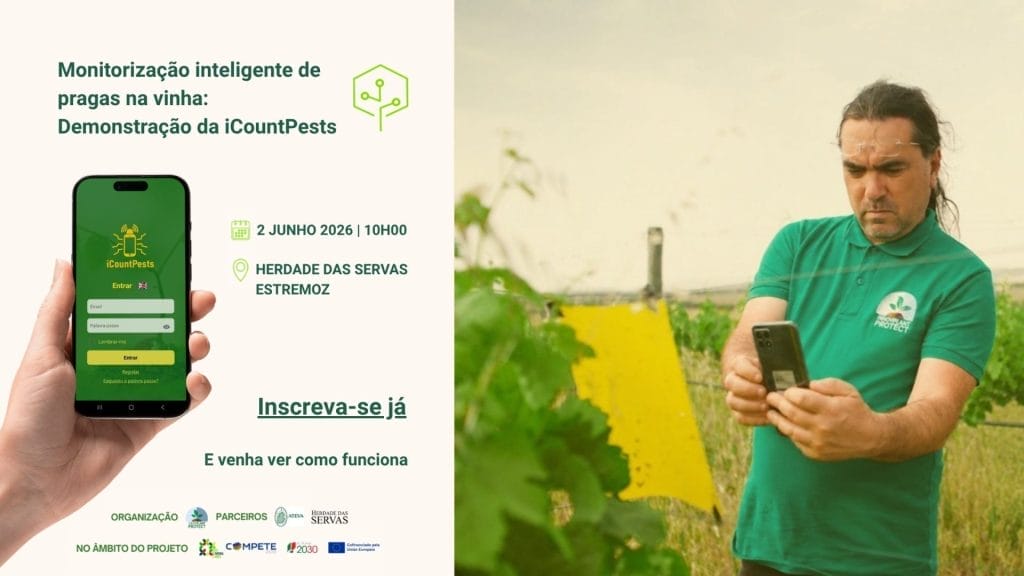
BannerDivulgacao iCountPests

Programa:

Receção dos participantes | 09H30

Apresentação sobre as pragas cigarrinha-verde (Jacobiasca lybica) e curl moth (Cryptoblabes gnidiella) | 10H00

Nuno Faria | Investigador da área de Monitorização Inteligente de Pragas e Doenças

Apresentação da app iCountPests | 10H20

Ricardo Ramiro | Diretor da área de Ciência dos Dados e Bioinformática

Coffee break e momento de networking 10H45

Demonstração da app em ambiente real 11H00

A participação é gratuita, mas sujeita a inscrição prévia. Para garantir uma experiência prática e próxima dos participantes, as vagas são limitadas a 30 participantes. Para se inscrever basta preencher o formulário disponível here.

Marque na sua agenda e junte-se a nós! Teremos todo o gosto em recebê-lo/a!

📅 Data: 2 de junho de 2026
🕙 Hora: 10h00
📍 Local: Herdade das Servas, Estremoz

Esta ação é realizada no âmbito do projeto BioLivingLABS: Bioeconomy at the service of the sustainability of inland territories, cofinanciado pelo COMPETE 2030, que visa aproximar a ciência das empresas e dos produtores, transformando os resultados da investigação em soluções práticas e sustentáveis que tragam valor económico e ambiental aos territórios de baixa densidade das regiões Norte, Centro e Alentejo. 

O consórcio integra cinco instituições de investigação e inovação – o Instituto Politécnico de Bragança (IPB), the Polytechnic Institute of Castelo Branco (IPCB), o Laboratório Colaborativo Montanhas de Investigação (MORE CoLAB), o InnovPlantProtect e o Centro de Valorização e Transferência de Tecnologia da Água (AquaValor).

iCountPests: nova app para monitorização automática de pragas já disponível

Já está disponível a iCountPests, uma nova aplicação desenvolvida pelo InnovPlantProtect para apoiar a monitorização de pragas agrícolas através da análise automática de imagens captadas em campo.

A app utiliza inteligência artificial para contabilizar automaticamente pragas presentes em armadilhas adesivas, permitindo obter resultados rápidos e fiáveis diretamente no telemóvel.

Pensada para produtores e técnicos agrícolas, a iCountPests contribui para uma monitorização mais eficiente e precisa, reduzindo o tempo associado às contagens manuais e apoiando a tomada de decisão na proteção das culturas.

O funcionamento é simples:

  1. Captar uma imagem da armadilha
  2. Analisar automaticamente
  3. Consultar resultados organizados e acessíveis

A app permite ainda acompanhar a evolução das pragas ao longo do tempo, facilitando a gestão e o registo da informação no terreno.

Saiba mais sobre a iCountPests here.

Brevemente disponível: nova app iCountPests vai transformar a monitorização de pragas

A monitorização de pragas é uma tarefa essencial na gestão agrícola, mas continua a depender, em muitos casos, de processos manuais demorados e sujeitos a erro.

A pensar nesta realidade, o InnovPlantProtect irá lançar brevemente a iCountPests, uma aplicação inovadora que utiliza inteligência artificial para automatizar a contagem de pragas a partir de imagens captadas no campo.

Com a iCountPests, será possível obter resultados rápidos e fiáveis, contribuindo para uma tomada de decisão mais informada e eficiente na proteção das culturas.

A aplicação estará brevemente disponível, sendo direcionada a produtores agrícolas e técnicos que procuram otimizar o tempo dedicado à monitorização e melhorar a precisão dos dados recolhidos.

Saiba mais sobre a iCountPests here.

EVENTS

Comparing genomes to understand the “tricks” of microbes

Sometimes, if you're inside a building, it's hard to tell whether or not it's raining outside. However, you will easily conclude that it is raining if you see people with open umbrellas. The umbrella is an accessory that helps human beings deal with their environment.

Bacteria can also use “accessories” to better cope with their environments. These accessories, however, have much more profound effects on the lives of microbes, as they take the form of genes that can be integrated into their own genomes. These “accessory” genes are obtained from other microbes or from the environment, and can play various roles, from allowing bacteria to resist antibiotics to enabling symbiotic associations with plants.

Image: Adrianna Calvo/ Pexels

At InPP, the Data Management and Risk Analysis Department is comparing bacterial genomes to identify those that have “accessory” genes that can help plants defend themselves better against pathogens. On the other hand, these analyses also allow us to rule out bacterial strains that could have adverse effects. This information will be crucial for identifying microbes and microbial characteristics that are important for plant protection.

First gene transfer from a plant to an insect identified

Tobacco whitefly uses a stolen gene to avoid the host's defenses. The discovery is highly relevant to pest control.

The first known case of a natural gene transfer from a plant to an insect has been identified by an international team of researchers. The insect is a whitefly and the discovery could pave the way for new pest control strategies, according to a report published in the newspaper Nature.

Scientists have discovered that Bemisia tabaci appropriated a gene from a host plant millions of years ago, reveals a article published in Cell. The gene allows this pest to neutralize a toxin produced by certain plants to defend themselves against insects.

Some whiteflies use plant genes to render toxins harmless. Image: Gaucho/ Wiki

This aleirodid, also known as the bean or sweet potato whitefly, although it attacks many other vegetable crops, is a worldwide pest and one of the most destructive we know of. A Bemisia tabaci ingests the sugary sap of hundreds of types of plants, excreting a sweet, sticky substance, honeydew, which then serves as a medium for fungi to grow. Whiteflies are also vectors for more than a hundred viruses that are pathogenic to plants.

“It's a remarkable example of how the study of evolution can underpin new approaches to applications such as crop protection,” says Andrew Gloss, who studies plant-pest interactions at the University of Chicago in the USA. The study suggests that inhibiting the gene identified could make this whitefly vulnerable to the toxin, opening up a new way of combating this pest.

Alternative strategy to protect crops without genetic modification

Protecting plants from pathogens without genetically modifying crops? A team of Chinese researchers suggests an alternative strategy in the latest issue of Plant Communications.

The biotechnological methods that currently exist to create crops that are resistant to pests and diseases are limited in their applicability, mainly because they are based on transgenics or surface application (which does not allow access to the inner areas of the plant). A scientists' proposal involves the use of small RNA produced by beneficial microbes for crop protection, guaranteeing the stability and delivery of these RNAs to the appropriate place and time.

RNA associated with beneficial microbes in the microbiome to protect crops against pathogens.

The strategy, which eliminates “the need for genetic modification of cultures”, assumes that small RNAs (sRNAs) can be transferred from the microbiome to the host and pathogen, or between elements of the microbiome.

sRNAs are the crucial molecular devices of so-called gene silencing via RNA interference, a mechanism that regulates gene expression at both the transcriptional and post-transcriptional levels.

Title of original article: Trans-kingdom RNAs and their fates in recipient cells: advances, utilization, and perspectives

doi.org/10.1016/j.xplc.2021.100167

